Option 1 — Individual
$29 per frontline worker
One-time payment · Immediate access
Option 2 — Team Bundle (Most Popular)
10 Staff Bundle — $250
Equivalent to $25 per worker
· One-time payment
Developed by a Registered Nurse with a Master of Mental Health Nursing and 16 years in acute mental health.
Option 3 — Large Team Bundle
30 Staff Bundle — $800
Covers most small to medium providers
· One-time payment
The gap between induction training and the real complexity of NDIS frontline work is where incidents happen.
Your workers are making complex decisions every shift, about risk, behaviour, boundaries, and escalation, without the clinical training those decisions require.
When a worker hesitates, guesses, or documents vaguely, the consequence doesn't stop with them.
It lands on your service.
When staff feel supported with structure and guidance they stay,
and your whole service stabilises.
Incidents that should never happen start happening
Risk is missed, minimised, or escalated at the wrong time
Documentation becomes vague and creates compliance exposure
Workers send mixed messages across shifts
Small issues snowball upward to management and crisis teams
Staff burn out and leave — costing you $10,000–$16,000 per replacement
Untrained frontline decisions cost providers far more than training ever will.
Training gaps increase incidents, complaints, and escalation to leadership.
The longer these issues continue, the more they cost your service in preventable complaints, reportable incidents, staff turnover, increased management workload, and reputational damage.
Your organisation becomes reactive instead of safe, predictable, and stable.
43–62% of NDIS workers report frequent burnout
17–25% leave each year
Up to 70% of NDIS incidents stem from inconsistent frontline responses
Each worker replacement costs $10,000–$16,000
Workforce demand is projected to grow 84% by 2030
This training gives your team one shared structure,
one shared language, and one consistent safety-first approach, across every shift.

When frontline workers follow the same clinically informed framework, your service becomes calmer, safer, and easier to manage.
Your organisation gets:
Fewer preventable incidents and complaints
Staff who feel confident, supported, and stay longer
Clear, defensible documentation that holds up during audits
Correct escalation pathways every time
Less pressure on management and team leaders
A stable, reliable service even during challenging presentations
This training doesn't add pressure. It removes uncertainty.

What your team will learn
Workers learn clear role definitions, how to maintain safe professional boundaries, and how to redirect participants without harming rapport. This directly reduces complaints, grey-area care, and issues that escalate to management.
A unified framework for identifying early risk indicators and responding safely, before situations escalate to crisis, hospital transport, or emergency services.
Workers learn to observe and document what clinicians need to see. This improves communication with mental health services, GPs, and crisis teams, and strengthens your service's professional reputation.
Tools for managing the emotional load of frontline work, reducing burnout, and building the kind of stable workforce that delivers consistent, high-quality support.
WHAT EACH ENROLLED WORKER RECEIVES
Full access to all 14 clinician-developed lessons
20 downloadable, practical worksheets
Clear frameworks for safety, documentation, and escalation
Certificate of completion
Access to all future updates
COMPLETION TIME
Most workers complete the training in 60–90 minutes.
Fully online and self-paced, no scheduling required.
Simple, one-time pricing. No subscriptions. No lock-in contracts.
Option 1 - Individual
$29 per frontline worker
One-time payment · Immediate access
Option 2 - Team Bundle (Most Popular)
10 Staff Bundle - $250
Equivalent to $25 per worker
· One-time payment
Option 3 - Large Team Bundle
30 Staff Bundle - $800
Covers most small to medium providers
· One-time payment
One-time payment. Immediate access for all enrolled workers.
Track completion via certificate of completion.
For bulk enquiries: hello@theresilienceecho.com
"We don't have the budget for training right now."
This is the most common reason providers wait - and the most expensive mistake they make.
Consider what you are already paying for:
One preventable incident requiring management time and documentation = hours of lost productivity
One staff member leaving and being replaced = $10,000–$16,000
One NDIS compliance issue triggered by poor documentation = significant organisational risk
A 10-staff bundle costs $250.
That is less than one hour of a consultant's time. Less than one shift of agency staff cover.
Less than the administrative cost of one complaint.
The question is not whether you can afford this training. It is whether you can afford what happens without it.
Developed by a frontline clinician. Not a training company.

This training was developed by Joanne Eussen. A Registered Nurse with a Master of Mental Health Nursing and over 16 years of experience in acute mental health settings.
Every lesson reflects real frontline clinical decision-making under pressure, including assessment, escalation, and documentation in high-risk situations involving:
Suicidal ideation and self-harm
Severe emotional dysregulation
Psychosis, intoxication, and trauma responses
Complex behavioural presentations in community settings
This is not theory pulled from a textbook.
It is the exact clinical framework frontline staff need, and adapted specifically for NDIS environments and support worker scope.
Built for NDIS environments
Disability and dual-diagnosis context
Early-warning recognition
Trauma-informed focus
Boundaries and emotional labour
NDIS documentation training
Reduces incidents
Improves staff retention
Clinically developed for psychosocial work
Generic Mental Health
❌
❌
Minimal
❌
❌
❌
❌
❌
❌
Mental Health First Aid
❌
❌
Limited
❌
❌
❌
❌
Limited
❌
NDIS Frontline Safety & Behaviour
Response Training
✅
✅
✅
✅
✅
✅
✅
✅
✅
Frequently Asked Questions
Q: Will this training actually reduce incidents?
Yes. Up to 70% of NDIS incidents stem from inconsistent frontline responses and missed early-warning signs. This training reduces incidents by strengthening early recognition, predictable responses, escalation timing, and defensible documentation.
Q: Is this suitable for new and experienced staff? Both. It meets workers where they are. Building confidence in newer staff while reinforcing consistent practice in experienced workers.
Q: How long does the course take to complete?
Most staff complete the training in 60–90 minutes. It is fully online and self-paced, so no scheduling is required.
Q: Does this support NDIS compliance? Yes. While not a replacement for mandatory modules like Worker Orientation, this training directly supports your service to meet key NDIS Practice Standards around behaviour support, safety, professional boundaries, documentation, and staff capability.
Q: Can I track staff completion? Yes. Each enrolled worker receives a certificate of completion. For team bundles, a tracking sheet is available on request.
Frontline capability is no longer optional in the NDIS.
It is the difference between a reactive service and a stable one.
Simple, one-time pricing. No subscriptions. No lock-in contracts.
Option 1 - Individual
$29 per frontline worker
One-time payment · Immediate access
Option 2 - Team Bundle (Most Popular)
10 Staff Bundle - $250
Equivalent to $25 per worker
· One-time payment
Option 3 - Large Team Bundle
30 Staff Bundle - $800
Covers most small to medium providers
· One-time payment
One-time payment. Immediate access for all enrolled workers.
Track completion via certificate of completion.
For bulk enquiries: hello@theresilienceecho.com
Also by Joanne Eussen
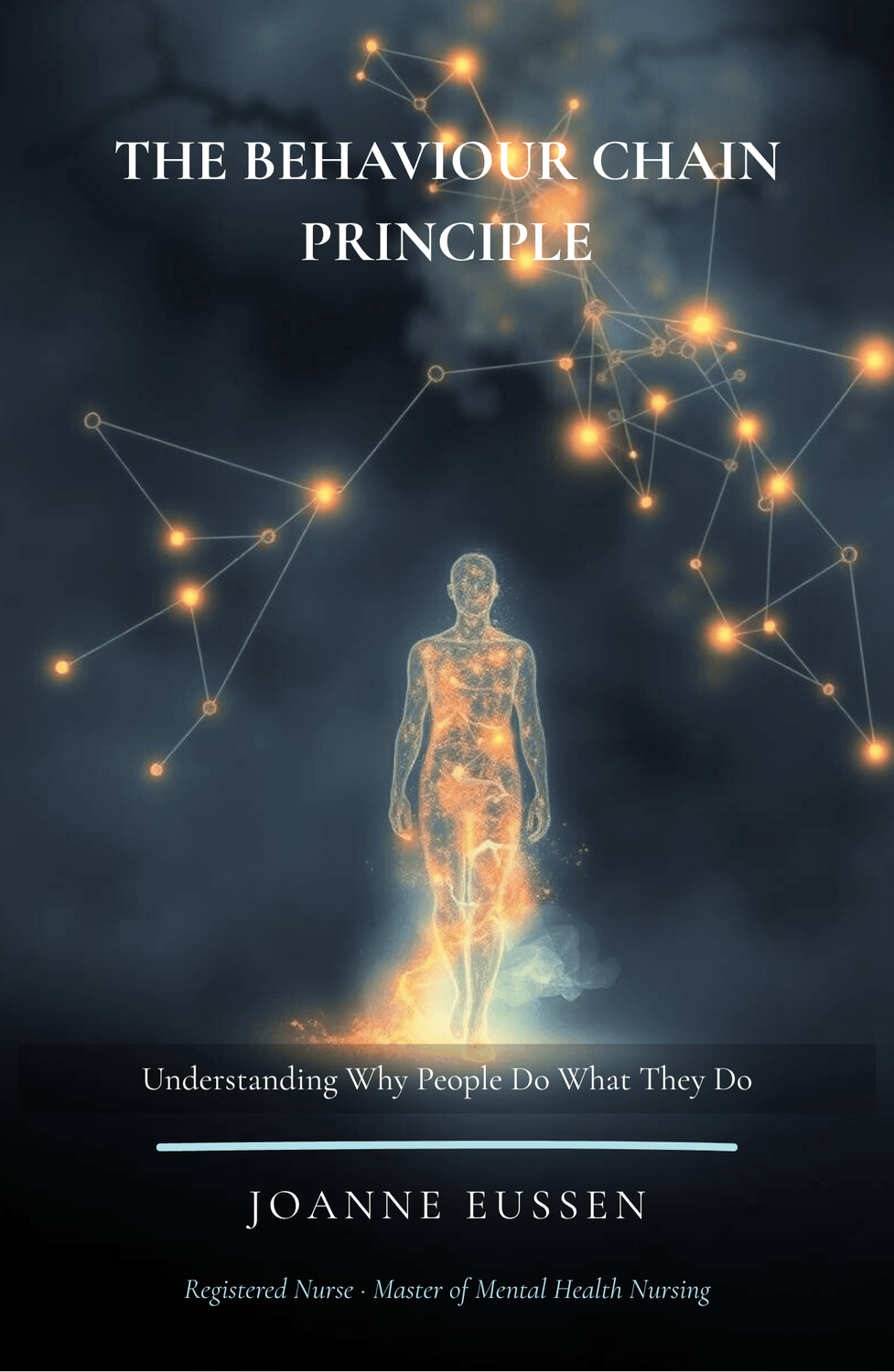
The Behaviour Chain Principle - Understanding Why People Do What They Do
A practical framework for anyone supporting people whose behaviour is sometimes confusing, challenging, or heartbreaking.
Disclaimer:
This training provides general educational content only. It is not an accredited qualification and is not provided under an RTO.
Workers must follow their organisation’s procedures, legislation, and scope of practice.
The Resilience Echo
Clinician-developed training for NDIS frontline teams
© The Resilience Echo. All rights reserved.
For course enquiries: hello@theresilienceecho.com